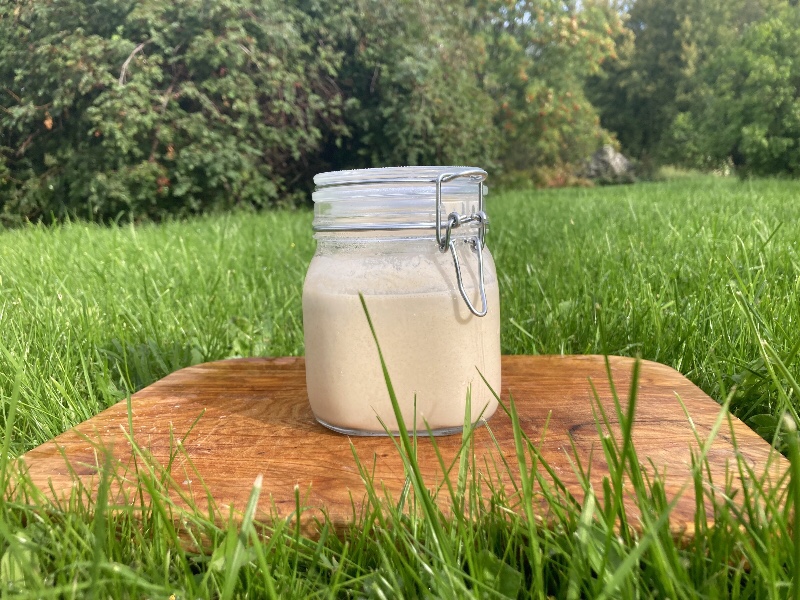
I decided to make my own sourdough bread using starter grown from scratch, but without all the hassle maintaining a sourdough starter seemed to involve.
The idea is simple enough: equal parts flour and water, mix it together and let the wild yeast do it’s thing.
The recipe started with 1 dl high fibre wheat flour and 1 dl water. All mixed together in a yoghurt maker. The high-fibre flour is, according to the label, apparently not the same as whole wheat, but is somehow ground from the portion nearest the husk, consisting of 75% kernel and the rest is the inner part of the husk. Compared to all-purpose it’s very slightly browner.
I decided to place the yoghurt maker out in the garden, where it smelled nice in order to try to entice a suitable colony of wild yeast to settle. Nicest scent that day happened to be around the rowan-berry tree.
For added persuasion I placed some berries and wild grass on top of the tissue covering the container and left it in the not-overly-strong-that-day sun.
The container was brought in in the evening and placed under it’s fairly tight-fitting lid and left on the counter.
Next morning it looked like it was off to a good start, the starter had obviously risen during the night and left dried traces on the side of the container.
Repeat feeding with the same amount and out in the garden again. In the evening it still looked good and had a nice doughy-yeasty smell.
The third day was slightly warmer with more sunshine and when checked in the middle of the day there was a slight amount of vinegary liquid on top of the starter.
A quick Internet troubleshooting seemed to indicate that the starter had probably been overstimulated by the temperature and was now underfed.
I said “fuck it” and upped the feedings to two, mixing everything together and placed the container in a more shadowy spot.
The following day seemed to indicate that it was indeed going full-tilt and still too vinegary with an excess of liquid, so I removed around 1/2 dl of the vinegary liquid and adjusted the feedings to 1/2 dl of flour three times per day, with no added water in order to make the consistency slightly sturdier. I also decided to keep it under cloth in case the lid happened to make conditions in the container too anaerobic.
The presence of bubbly activity after each feeding indicated that the culture was alive and well and just needed to get the right balance.
The morning of the fifth day indicated that the strategy was successful. The starter was last fed in the evening leaving it slightly sturdier, but still running easily off a spoon. Now it seemed to be peaking, almost running over the edges of the container. The vinegary smell was also gone, replaced by a fresher apple-like aroma. Victory!
Now it was all a matter of maintaining the balance. I decided to start using spring water to top it up when necessary, in order to hinder any chlorine that might be in the tap water from interfering with the yeast.
The sixth day it seemed like the starter had reached a balanced state and one feeding of about 1/2 dl flour in the morning was enough to last until evening when kept at room temperature.
In the evening on the seventh day I decided to try baking with it and transferred the rest of it to a lidded jar in the fridge.
The starter, that I’ve preliminarily decided to call “Bob” has performed admirably for several bakes now and seems to be improving as it develops. The result of the first few bakes and any new insights will be published in the following chapters.
Update:
Bob was left alone in the refrigerator during a longish summer trip, and upon return was found to have developed a suspicious colouring along with a pungent smell.
In the interest of health and general wellbeing, Bob had to be let go.
A new starter was started, this time with a small amount of commercial fresh yeast as base.
The performance is slightly better, but the taste seems very similar, and the maintenance procedures are identical.
The new starter is now named ”Alice”.


- Asian Pork Hamburger on Rye | Recipe
- Shrimp and Avocado Salad with Lime Cilantro Dressing | Recipe
- Seared Pork Fillets with Creamy White Wine Dijon Sauce | Recipe
- Chicken Paprika | Recipe
- Goat’s Cheese Salad with Roasted Sourdough Bread | Recipe
To get free updates on the latest, enter your email and tap News.
 The Food and Booze Logs
Leave a comment